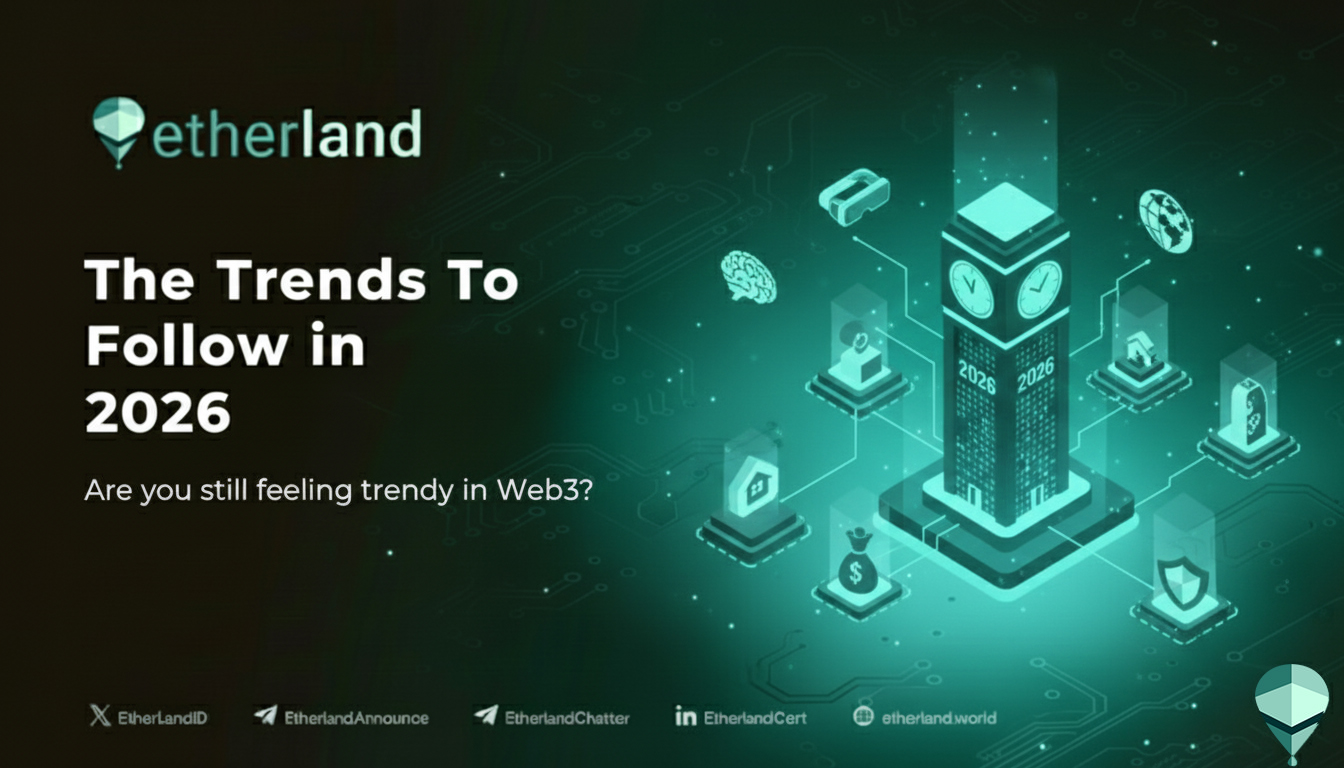
Let’s cut through the noise and examine the trends that will define Web3 in 2026, backed by real data and market insights.
The 2025 Recap
Before diving into trends, consider the scale of transformation underway. The global DeFi market grew from $21.04 billion in 2024 to $130 billion at the end of 2025, with projections reaching $1,558.15 billion by 2034!
Meanwhile, the Web3 gaming market is valued at $28.31 billion in 2025 and expected to surge to $117.47 billion by 2034. These aren’t just impressive numbers, as they represent fundamental shifts in how we think about ownership, value exchange, and digital interaction. The infrastructure supporting these changes is becoming more robust, scalable, and, crucially, more user-friendly. Many other sectors also indicate positive projections.
Now, let’s get to exploring the trends!
1. Wall Street Goes DeFi: From Fringe to Foundation
The tokenization is sitting in its 1996 Internet moment. Back then, Amazon had barely sold $16M in books, and several of today’s biggest tech giants didn’t even exist. That same curve is now forming around RWA. The sector is moving really fast. According to a 2025 projection by Standard Chartered on tokenized real-world assets, “RWA,” excluding stablecoins, the RWA market is expected to reach approximately $2 trillion by 2028, up from around $35 billion today. The next decade will be about real & multi-module scalable infrastructure.
For 2026, expect the following:
- More traditional banks offering DeFi-integrated services
- Regulatory frameworks are becoming clearer, especially in the U.S. and EU
- Corporate treasuries allocating to yield-generating DeFi protocols
- Cross-border settlements are moving to blockchain rails, reducing transaction times from days to minutes.
Key opportunities will be the projects that bridge traditional finance with DeFi infrastructure, which will capture significant market share with platforms offering compliant, institutional-grade interfaces to decentralized protocols.
2. Real-World Asset (RWA) Tokenization: Bridging Physical and Digital
RWA tokenization is moving from concept to reality, and the numbers are staggering. The value of tokenized real-world assets grew from $5 billion in 2023 to over $20 billion by the end of 2025.
What’s being tokenized? What’s being tokenized spans across real-world assets, including real estate, commodities, private credit, and fine art. As of November 2025, the total tokenized-asset market has reached about $40 billion, with private credit alone accounting for roughly $18.9 billion, and tokenized commodities—led by gold—estimated at around $1.9 billion.
The appeal is straightforward: fractional ownership, increased liquidity, and 24/7 global markets for assets that were previously illiquid or inaccessible. In 2026, we’ll see:
- Major real estate portfolios tokenized for fractional investment
- Supply chain assets tracked and traded on blockchain
- Art and luxury goods are authenticated and traded as digital certificates
- Agricultural commodities tokenized for transparent farm-to-fork tracking.
Investment thesis: RWA platforms that solve regulatory compliance and provide seamless fiat on-ramps will dominate. The tokenization of traditionally illiquid assets creates new investment opportunities for retail and institutional investors alike.
3. AI Meets Blockchain: The Intelligence Layer
The convergence of AI and blockchain represents one of the most transformative trends for 2026. The combined market size of AI and blockchain technologies exceeded $703 million by the end of 2025, with a CAGR of 25.3%.
This isn’t just about ChatGPT analyzing crypto prices. The integrations will run deeper:
- Decentralized AI agents: Autonomous AI agents operating on blockchain networks can analyze data, execute tasks, and make decisions without central control. These agents optimize DeFi strategies, manage DAOs, and provide personalized experiences while maintaining privacy.
- Enhanced security: AI-powered fraud detection on blockchain networks identifies suspicious patterns in real-time. Machine learning models monitor wallet interactions and flag anomalies, making DeFi safer for institutional adoption.
- Smart contract evolution: AI-augmented smart contracts adapt to changing conditions, optimize gas fees, and execute complex multi-step transactions more efficiently.
- Forward look: In 2026, blockchain will provide the trust layer AI desperately needs. As autonomous agents make more decisions, immutable on-chain logs ensure accountability, compliance, and transparency at scale.
4. Web3 Gaming: From Play-to-Earn to Play-AND-Own
The Web3 gaming sector faced a reckoning in 2025. Early play-to-earn models proved unsustainable, and many projects failed. But from this shakeout, a more mature ecosystem is emerging.
North America dominated the Web3 gaming market with a 36.84% revenue share in 2025, while the Asia Pacific is anticipated to grow at the fastest rate of 21.72% during the forecast period.
The 2026 gaming landscape is characterized by:
- True ownership over speculation: Players want functional NFTs—assets they can actually use across games, not just flip for profit
- AAA quality: The gap between traditional and Web3 games is closing, with studios focusing on gameplay first, blockchain second
- Cross-platform interoperability: Your sword from one RPG works in another; your character skin travels across metaverse worlds
- Sustainable economies: Moving beyond unsustainable token emission models to genuine player-driven economies.
Simon Davis of Mighty Bear Games noted that teams will focus on what Web3 players actually want: a chance to win money, prizes, or capture asymmetric upside. The future isn’t about making traditional games with blockchain bolted on—it’s about embracing what makes Web3 gaming unique.
Market reality: By 2026, successful Web3 games will offer compelling gameplay that happens to use blockchain, rather than blockchain games that happen to be playable.
5. Decentralized Social Media: Ownership Meets Community
Let’s head to another trend. The global blockchain messaging apps market was valued at $65.76 billion in 2024 and is expected to reach $1226.53 billion by 2032, growing at a CAGR of 44.27% during 2025-2032.
Decentralized social networks offer things like:
- User control: You own your account, content, and follower relationships
- Portability: Move between platforms without losing your audience
- Censorship resistance: No single entity can deplatform you
- Open-source governance: Communities decide on platform rules and features.
But what’s the challenge? Content moderation at scale without centralized oversight, as each network or server enforces its own rules, making safety and trust harder to maintain. But for users tired of algorithmic manipulation and data exploitation, the value proposition is compelling.
2026 Prediction: Expect hybrid models where traditional social platforms integrate Web3 features (tokenized rewards, NFT verification) while native Web3 social networks improve user experience to compete with Web2 incumbents.
6. NFT Evolution: From JPEGs to Utility
The NFT market matured significantly over the years, going from ups to downs and finally moving beyond speculative digital art to genuine utility. NFTs are driving creator monetization, esports engagement, and fan participation models.
In 2026, NFTs will represent perks like:
- Event access: Concert tickets, exclusive experiences, VIP memberships
- Gaming assets: Functional items with cross-game utility
- Digital identity: Verified credentials, achievements, reputation systems
- Creator economies: Direct artist-to-fan relationships without intermediaries.
Sony announced the launch of a new Fan Marketing Platform compatible with the Soneium chain, aimed at NFT issuance and analysis, entering Web3 gaming-adjacent fan engagement ecosystems.
The speculation bubble burst, but utility-driven NFTs are thriving. Projects focused on solving real problems: ticketing fraud, digital identity, supply chain verification—are capturing sustainable value.
7. Regulatory Clarity: The Double-Edged Sword
Moreover, 2026 is expected to be a pivotal year for Web3 regulation. The EU’s Markets in Crypto-Assets (MiCA) regulation provides a framework, while the U.S. debates comprehensive crypto legislation.
France granted Circle an E-money license, enabling global USDC issuance inside a regulated framework and boosting stablecoin float by 78% year over year. This represents the kind of regulatory approval that builds institutional confidence.
The implications:
- Compliance becomes a competitive advantage: Projects with proper legal structures will access institutional capital
- Regulatory arbitrage: Jurisdictions offering clear frameworks (UAE, Singapore, Switzerland) will attract projects and talent
- Innovation within guardrails: Clear rules enable sustainable growth rather than regulatory whiplash.
Moreover, 71% of Asia-based institutional investors now consider tokenized assets viable portfolio components, largely due to increasing regulatory certainty.
Strategic note: Projects that proactively embrace compliance and transparency will outlast those hoping to avoid regulatory scrutiny. The wild west phase is ending; the infrastructure phase is beginning.
Practical Implications: What Should You Do?
If you’re building in Web3, investing in crypto, or evaluating this space for your business, here’s what matters:
For Developers:
- Focus on user experience first, blockchain second
- Build on mature Layer 2 infrastructure for cost-effective scaling
- Prioritize security audits and compliance from day one
- Consider AI integration for enhanced functionality.
For Investors:
- Look beyond hype cycles to fundamental utility
- Institutional-grade DeFi platforms with clear revenue models
- RWA tokenization platforms with regulatory compliance
- Gaming studios building AAA experiences with Web3 features
- AI-blockchain infrastructure projects are solving real problems.
For Businesses:
- Explore tokenization of company assets or loyalty programs
- Consider blockchain for supply chain transparency
- Evaluate DeFi for treasury management and cross-border payments
- Test Web3 marketing and community engagement strategies.
The Reality Check
Not everything in Web3 will succeed. Many projects will fail, regulatory uncertainty persists, technical challenges remain, and the user experience still lags Web2 in various areas.
But the trajectory is unmistakable! Web3 isn’t replacing the Internet, adding layers of ownership, transparency, and economic alignment that were impossible before. As the infrastructure is maturing, institutional capital is flowing in, and the real-world problems are being solved. The trends outlined above are the movements are already in motion, backed by billions in capital and millions of users. The early adopters who dismissed Web3 as a fad are revising their stance.
Are you still feeling trendy in Web3? Because in 2026, “trendy” becomes “fundamental.” The technology that seemed experimental is becoming essential infrastructure. The question is whether you’re building, investing, or adapting—or watching from the sidelines as the digital economy transforms around you.
The future of Web3 isn’t coming by itself, as it’s our job to build it. And the Etherland team is the one to set an example.
Ready to explore more trends with us?
- Visit https://etherland.tech/ to check our website and Medium blog
- Join our community on Discord and Telegram
- Follow and support on X.
Want to know how our products can fit your needs? Have a financial solution to help us build? Book your meeting here!