

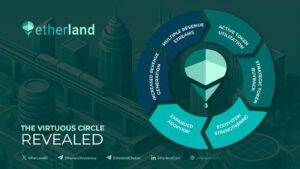
In the world of blockchain infrastructure, most projects follow a predictable pattern: build a product, launch a token, generate hype, and watch adoption flatline.
The real estate sector has undergone quite a transformative shift during the last decade as blockchain technology has integrated into every aspect of property transactions and management. From enhancing transparency and security to simplifying property management, blockchain is poised to be a game-changer. However, while the DLT has immense potential, the challenge of network fragmentation across different blockchain platforms has emerged as a critical barrier to mainstream adoption. This is where multichain solutions come into play, providing the essential bridge across various blockchain networks to enable smoother, more efficient operations in the real estate space. In this article, we will focus on how the Etherland team leverages the multi-chain direction.
At their core, multichain solutions refer to the ability to operate across multiple blockchain networks simultaneously. Unlike traditional single-chain platforms, which are confined to one blockchain, multichain solutions allow different blockchains to interoperate with each other seamlessly. This enables users to leverage the unique capabilities of various blockchains without being restricted to a single network.
In the context of real estate, multichain solutions are crucial in ensuring that property transactions, ownership records, and asset management can be conducted seamlessly across different blockchain ecosystems. By enabling interoperability between blockchain networks, multichain solutions address one of the key challenges faced by the real estate sector: network fragmentation.
The explosion of real estate tokenization in 2025 has made multichain infrastructure not just desirable but essential. Real estate applications using blockchain have surged 58% since 2022, focusing on tokenized property transfers and transaction cost reduction. And the numbers tell quite a compelling story:
As you can imagine, this explosive growth demands infrastructure that can move assets seamlessly between chains, something single-blockchain solutions simply cannot deliver at scale.
Real estate, by nature, is a global industry where transactions and operations span multiple countries, currencies, and legal frameworks. This globalism and scale create the need for diverse blockchain networks to handle different aspects of real estate management. Without an efficient way for these networks to communicate, the potential for blockchain in real estate is significantly reduced.
Multichain solutions serve as a bridge connecting these disparate blockchain networks, enabling seamless flow of real estate transactions and data between them. Here’s how this works:
Real estate platforms often operate on different blockchains, such as Ethereum, Binance Smart Chain, Solana, and others. Multichain solutions allow these networks to interact with each other, ensuring that transactions and data are easily transferred and recognized across various blockchains.
For example, an asset tokenized on Ethereum can be recognized and traded on Solana or Polygon, facilitating smoother cross-platform transactions.
Blockchain platforms often have their own set of transaction fees and time constraints. By utilizing multichain solutions, users can choose the most cost-effective and efficient blockchain for a particular task, reducing both the cost and the time associated with real estate transactions.
Real-world impact: One property firm cut international deal closures from 45–60 days to 9 days using blockchain, with fees dropping from $27,000 to $7,800 per deal, a 71% cost reduction. This efficiency gain is only possible when platforms can route transactions through the optimal blockchain for each specific use case.
Stablecoins now represent over 91% of daily trading volume, offering price stability for large-value real estate transactions while maintaining cross-chain compatibility. In Q2 2024 alone, stablecoin transactions totaled $8.5 trillion, more than double Visa’s transaction volume, thus demonstrating the infrastructure’s capacity for real estate settlement at scale.
Tokenizing real estate properties on blockchain networks allows for fractional ownership and easier asset management. Multichain solutions enable tokens representing real estate assets to be traded across various blockchain networks, providing investors with greater liquidity and access to a global market.
Institutional validation: BlackRock’s BUIDL fund crossed $2.5 billion by April 2025, demonstrating strong institutional appetite for compliant, yield-bearing on-chain assets.
The tokenization of real estate has exploded in 2025, with platforms demonstrating the power of multichain architecture.
For investors, this means a property tokenized on Ethereum can be easily traded on Polygon or Solana, expanding the market and creating unprecedented liquidity. Tokenized assets have also crossed the $5 trillion mark in market value, led by tokenized real estate and carbon credits.
The security of real estate transactions is paramount, and blockchain offers unparalleled transparency and immutability. With multichain solutions, real estate data, such as ownership records, transaction histories, and legal documents, can be securely stored across different blockchain networks. This ensures that the integrity of the data is preserved, even if one network faces technical issues or security breaches.
Infrastructure resilience: As of 2025, the total value locked in cross-chain bridges reached $19.5 billion, demonstrating the maturation of secure cross-chain infrastructure. The redundancy inherent in multichain architecture provides critical protection for high-value real estate assets. If Ethereum experiences congestion or elevated gas fees, transactions can route through Polygon or Binance Smart Chain without compromising security or data integrity.
And how does our project fit into this extensive picture? By adopting a multichain strategy, the Etherland team is creating an ecosystem that enables seamless interoperability between different blockchain networks. Our platform integrates with various blockchain ecosystems, offering real estate owners, investors, and developers the ability to manage properties and conduct transactions across multiple chains.
In fact, our multichain architecture allows users to tokenize properties, track ownership, and securely transfer assets across Ethereum, BSC, and Polygon networks, with more popular chain support coming later. This opens up new opportunities for fractional ownership, international property investments, and a more globalized real estate market. With support for W3C-compliant decentralized identities (DIDs) and integration with enterprise systems, the Etherland project exemplifies how multichain solutions remove barriers to blockchain adoption.
Furthermore, our Estatepedia, a decentralized database for real estate data, leverages multichain solutions to ensure that property data is accessible, secure, and interoperable across different blockchain platforms. This approach addresses the challenge of siloed data and promotes transparency in property transactions, which is essential for building trust in the real estate market.
Moreover, the platform’s ability to operate across multiple chains means users aren’t locked into a single ecosystem. You’re a developer preferring Ethereum’s security, an investor seeking Polygon’s low fees, or an institution requiring BSC’s throughput? Etherland’s infrastructure accommodates all use cases without forcing compromise.
As blockchain technology continues to evolve, the role of multichain solutions in real estate will only become more prominent. The ability to bridge multiple blockchain networks will enable faster, more secure, and more efficient real estate transactions on a global scale. Moreover, as tokenization becomes increasingly widespread, the need for multichain interoperability will grow, offering investors greater flexibility and access to diverse real estate markets.
Market projections are very positive: by 2030, the global market for tokenized real estate will reach up to $3 trillion and represent 15% of real estate assets under management. A BCG-Ripple report projects the tokenized asset market to grow from $0.6 trillion today to $18.9 trillion by 2033, with a CAGR of 53%!
Speaking of adoption, Banking dominates the blockchain market with a 29.7% share, highlighting its critical role in driving decentralized finance innovations. And with over 240 million active Web3 wallet users (growing 19% YoY) provides the user base for multichain real estate platforms. Enterprise-branded NFTs are used by 28% of Fortune 100 companies for community engagement, demonstrating corporate acceptance of blockchain infrastructure.
The convergence of institutional capital, regulatory clarity, and mature multichain infrastructure positions 2025-2030 as the breakthrough period for blockchain real estate. As one industry expert stated, “I don’t see how the entire real estate industry will not be on the blockchain within 10 years. It’s just here, and people are recording everything already on it, and it’s the most secure platform and technology to do it.”
Ultimately, multichain solutions will help unlock the full potential of blockchain in real estate, paving the way for more inclusive, transparent, and efficient property ownership and management.
As you can make a clear conclusion by this point, multichain solutions are not just a vital component, but they are the essential infrastructure bridging blockchain networks within the real estate industry. By enabling interoperability between different blockchains, these solutions facilitate smoother transactions, dramatically reduce costs, enhance security, and unlock global liquidity.
The momentum is undeniable, and as blockchain continues to reshape the industry, multichain solutions will play an essential role in creating a global, seamless, and transparent real estate market. There is literally no question whether multichain infrastructure will dominate real estate, but it’s how quickly traditional players will adapt to this new reality.
Ready to explore a multichain journey with us?
Want to know how our products can fit your needs? Have a financial solution to help us build? Book your meeting here!
In the world of blockchain infrastructure, most projects follow a predictable pattern: build a product, launch a token, generate hype, and watch adoption flatline.

The Web3 landscape is maturing at breakneck speed. What started as experimental blockchain projects and speculative NFT drops has evolved into a multi-billion-dollar ecosystem reshaping digital ownership, finance, gaming, and many other industries. As we enter the new year and decade, the real question is whether you’re prepared for what’s coming next.
The world of global data in the real world asset sector, real estate, asset management, and other industries is built on trust. Still, too often, trust is broken by outdated systems, old-fashioned approaches, and opaque data.

The world of finance is on the brink of a transformative revolution, with Real-World Assets (RWA) emerging as the groundbreaking sector for 2025 and beyond.
Want To Know How Our Products Can Fit Your Needs? Have A Financial Solution To Help Us Build?